We rebuilt the website of Seoul Choice Dental, a dental clinic near Dangsan and Mullae stations in Yeongdeungpo, Seoul, and launched it in November 2026. The old Wix site became a 132-page site in Korean, English, Japanese and Chinese with 19 treatment pages, set up for Naver and Google search with Dentist structured data. Here is what we built and why.
The new site at a glance
- 4
languages
Korean · English · Japanese · Chinese
- 132
pages
33 per language
- 19
treatment pages
from implants to myofunctional therapy
- 5
devices explained
3D CT · microscope · intraoral scanner and more
Before: what we fixed first
The old site was a Wix template. Before the design, the first thing to fix was what search engines read: part of the structured data that tells Google and Naver (Korea’s largest search engine) the clinic’s address still held the template’s placeholder text. Patients never see that data, but search engines and AI assistants read it word for word.
We set three goals: show information in the order patients ask for it; give every treatment its own page that can rank on its own; and follow medical advertising rules while still making the doctor’s principles clear.
The home screen: in the order patients ask
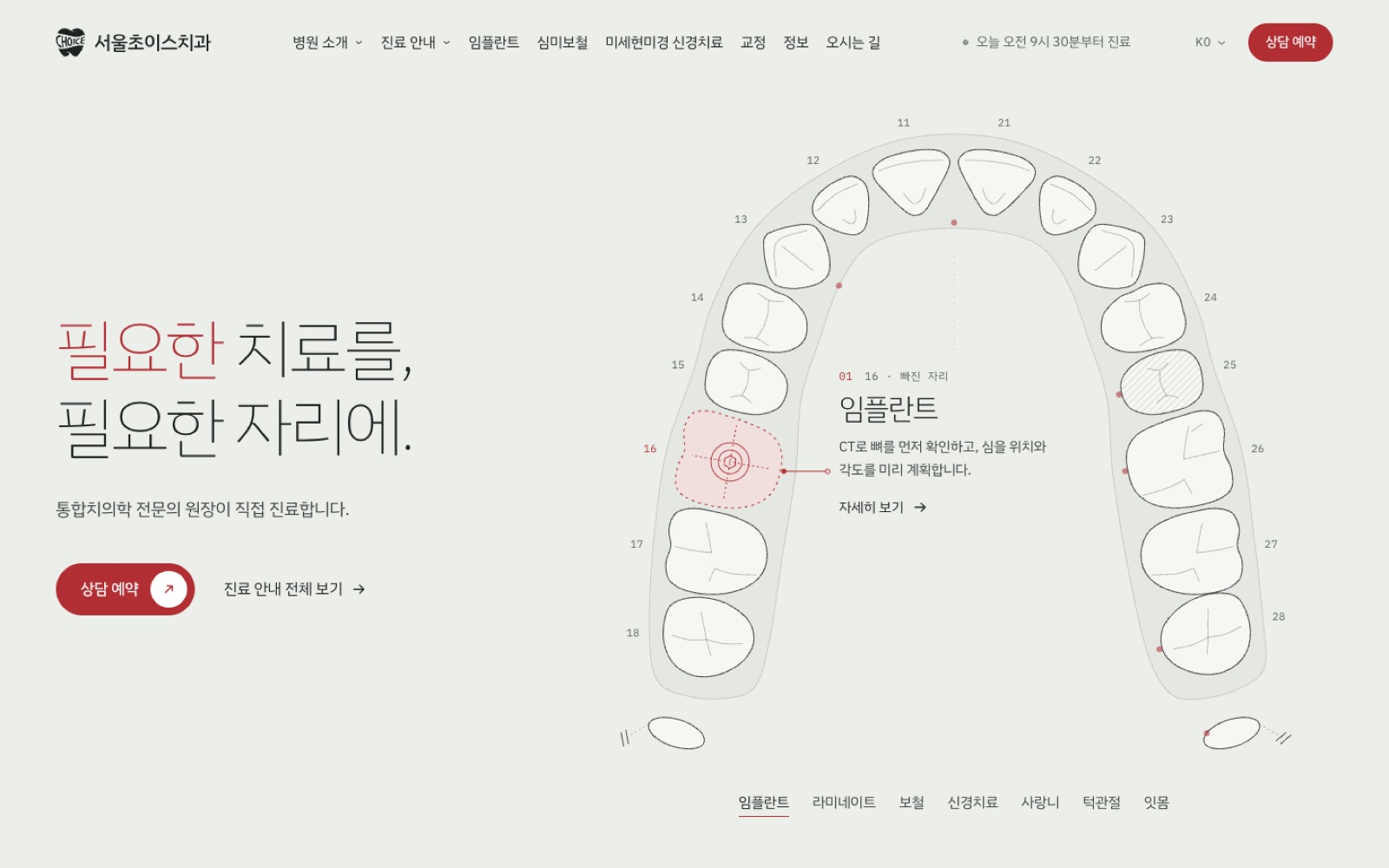
The headline reads “The treatment you need, where you need it,” followed by “A board-certified integrated dentistry specialist treats you herself.” On the right, a tooth chart lets patients pick implants, laminates, crowns and bridges, root canals, wisdom teeth, jaw joint or gum treatment, and the explanation and “Learn more” link change with it. The header shows live status such as “Open today from 9:30 AM,” and the Wednesday and Thursday late hours (until 8 PM) are written into the search description and the hours page.
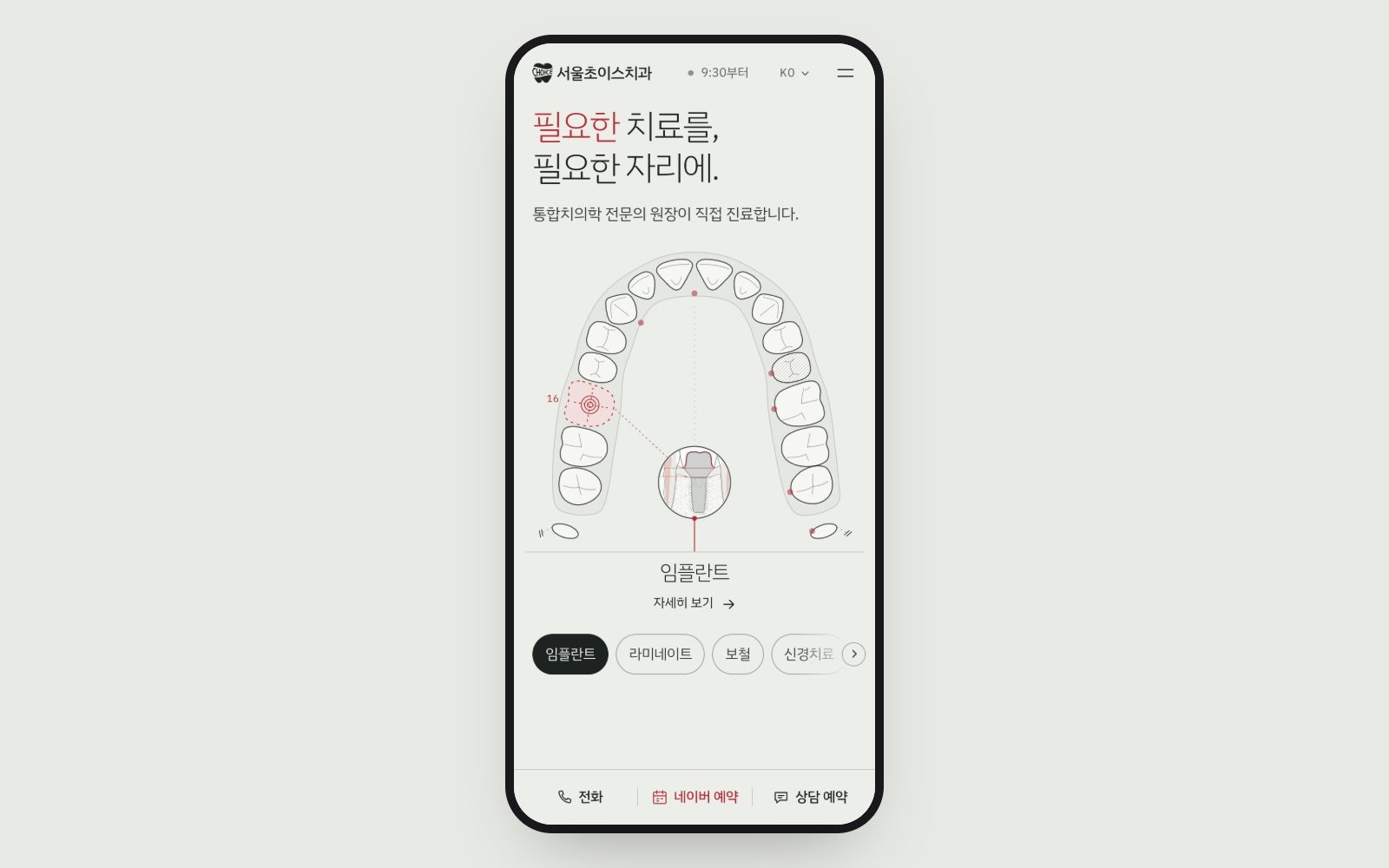
Most clinic-site visits happen on a phone, so the mobile layout keeps three buttons pinned to the bottom: call, Naver booking and consultation request. The clinic already takes bookings through Naver, so the site hands patients straight to the booking path they already know.
19 treatment pages, one structure
Implants alone split into navigation-guided, front-tooth, full-arch and implant-supported dentures, and patients search for each one separately. So the treatments became 19 pages.
The 19 treatment pages
- Implants: implants · navigation (guided) implants · front-tooth implants · full-arch implants · implant dentures
- Saving natural teeth: cavity treatment (resin, inlay) · microscope root canal · gum treatment · checkups and scaling
- Prosthetics and aesthetics: crowns and bridges · laminates · whitening · dentures
- Oral surgery and jaw: wisdom-tooth extraction · jaw joint (TMJ) treatment
- Orthodontics and kids: full orthodontics · clear aligners · pediatric care · myofunctional therapy
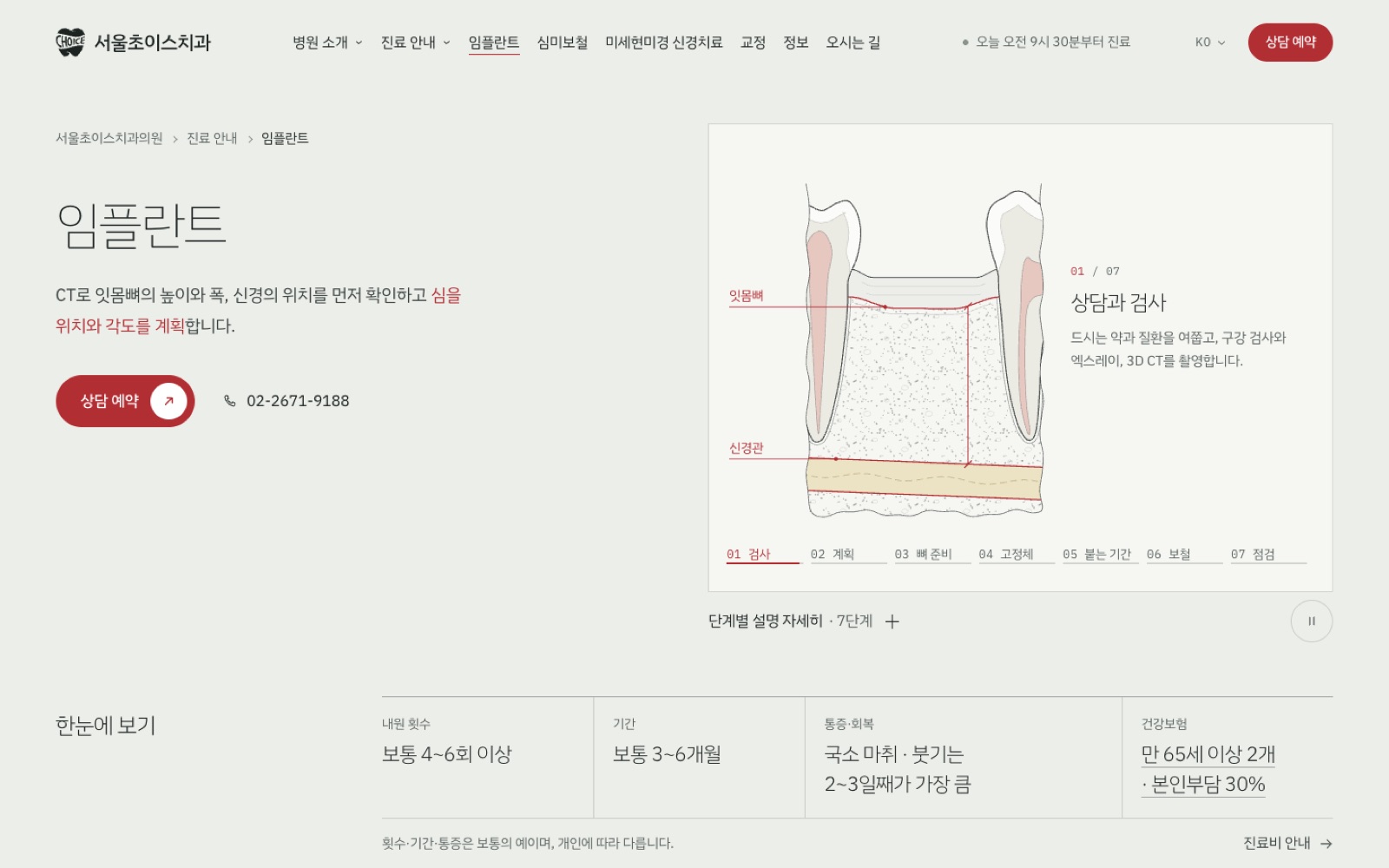
Every treatment page follows the same order: overview, treatment process, at a glance, frequently asked questions, summary. On the implant page, “At a glance” lists the usual number of visits (typically 4–6 or more), duration (typically 3–6 months) and national health-insurance coverage (two implants for patients 65 and older, 30% copay), with a note right below that these vary by patient. Patients find the same information in the same place on every page, and AI search such as ChatGPT and Google AI Overviews can quote the summary and FAQ directly.
Medical advertising rules and fee disclosure
Clinic websites in Korea fall under the medical advertising rules of the Medical Service Act. Instead of patient testimonials, superlatives like “best” or “only,” or comparisons with other clinics, the site states the doctor’s principles as facts. That is why the About page is organized under “We check first,” “We save natural teeth first,” “We do only the treatment you need” and “One doctor sees you from start to finish.”
The equipment page covers 3D CT (CBCT), a dental microscope, an intraoral scanner, implant surgical guides and a PRF centrifuge by name and by what each is used for. The clinic’s blog posts state limits and risks alongside benefits, with sections such as “Problems implants can still have” and “What a microscope does not change.”
Four languages: English, Japanese and Chinese patients too
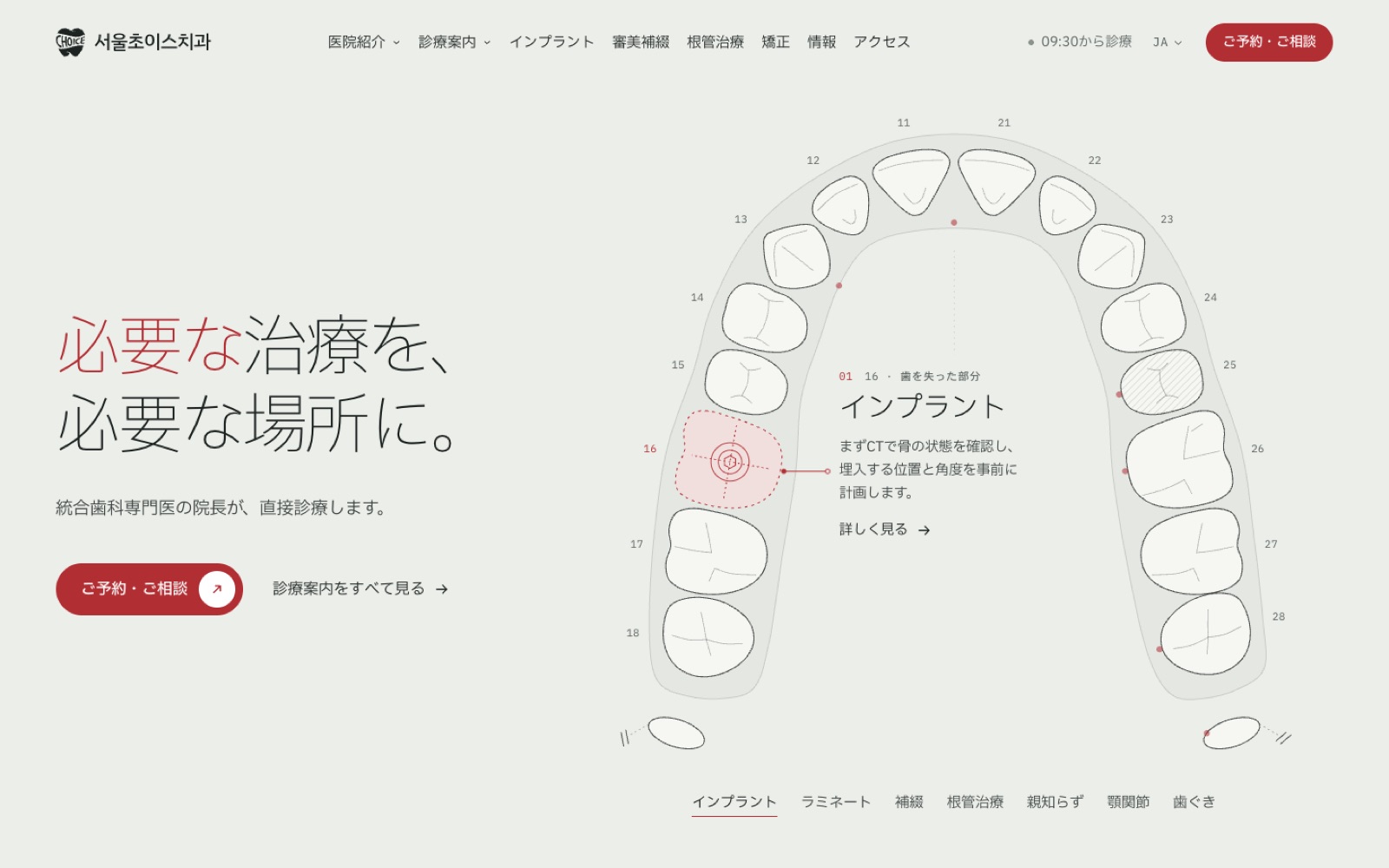
All 33 Korean pages were carried over into English, Japanese and Chinese, for 33 pages per language and 132 in total. Treatments, equipment, directions and booking keep the same structure, so foreign patients see the same information in the same order as Korean patients. The language switcher sits in the top right.
Ready for Naver, Google and AI search
Shipped with the launch
- Ownership verified in Naver Search Advisor and Google Search Console
- Sitemap: 132 URLs across four languages
- Dentist structured data: address, map coordinates, daily opening hours, phone, and service area (Yeongdeungpo-gu · Dangsan-dong · Mullae-dong · Yangpyeong-dong)
- Naver Place, the clinic’s Naver blog and Instagram linked to the same clinic (sameAs)
- A search title for every page, for example “Implants | Seoul Choice Dental”
- Four clinic blog posts to start, each opening with a key-points summary: choosing a dentist in Mullae-dong, why dentists use microscopes, what to ask at an implant consultation, and whether to extract or save a tooth
Search visibility does not appear on launch day. Naver and Google usually take a few weeks to crawl new pages and settle rankings. We will update this post as impressions and inquiries change.
Checklist before you rebuild a dental website
Check these on your current site first
- Does the structured data for search engines still contain template placeholder text or outdated information?
- Is the site registered in Naver Search Advisor and Google Search Console?
- Are opening hours, late hours and the nearest station visible on the first screen or in the search description?
- Does each treatment have its own page, or is everything crammed into one implant page?
- Can a patient call or book in one tap on a phone?
- Is the copy free of testimonials, superlatives and comparisons that medical advertising rules prohibit?
- Is there a non-covered fee page?