Vito's Pizza & Ristorante in Alpharetta, Georgia does what a good pizzeria should: dough made right, a dining room that smells like garlic and oregano, regulars who order 'the usual.' The kitchen runs on Toast POS. And when the owner signed with us recently, he believed — like most restaurant owners — that his website was a digital business card and his Google Ads were 'doing something.' Within the first week we found the truth: his ad campaign had been quietly optimizing for people who LOOK at menus, not people who order. This is the story of how we rewired one restaurant's website from brochure to revenue machine — and how the data led us straight to a catering business that had been sitting there the whole time.
A website is not a brochure. It is three roads that money travels.
Here is the mental model we wish every owner had. Customers reach a restaurant's revenue through exactly three roads. Road one: paid — someone sees your Google Ad, clicks to the website, and orders or calls. Road two: organic — someone searches 'pizza near me' or finds you on Google Maps, lands on the site, and converts. Road three: direct — a regular who already loves you goes straight to your online ordering (for Vito's, straight into Toast). Every dollar of online revenue takes one of these three roads. Which means every road has toll booths where money quietly leaks: an ad pointing at the wrong goal, a site Google doesn't trust, an ordering link buried three taps deep. You cannot fix a leak you cannot see — and a brochure-thinking website hides all three roads behind one pretty homepage.
The silent leak: Google Ads that counted window shoppers as wins
Vito's came to us with Google Ads already running. The account looked busy — clicks, impressions, and a healthy pile of 'conversions.' Then we opened the conversion settings and found the problem that defines this entire case study: the campaign was counting menu-page views as conversions. Think about what that instructs the algorithm to do. Google Ads is a machine that finds more of whatever you call success. Told that 'looked at the menu' equals success, it had spent months getting very, very good at finding people who look at menus — browsers, price-checkers, the idly curious — while actual orders, calls, and catering inquiries were nowhere in its definition of winning. The budget wasn't stolen. It was obediently spent on the wrong target.
The fix is unglamorous and decisive: we tore out the vanity events and rebuilt conversion tracking around real money. Completed online orders. Phone calls placed from the website. Clicks into the catering inquiry path. Once the campaign's compass pointed at revenue instead of curiosity, the algorithm began re-learning who Vito's actual customers are — the family ordering Friday pizzas, the office manager pricing trays for twenty — and bidding for them instead of for window shoppers.
What counts as a REAL conversion for a restaurant (and what never should):
- Real: a completed online order — money in the register, the only metric that cannot lie.
- Real: a phone call started from the website — for many restaurants, still where big orders happen.
- Real: a catering inquiry — a form submitted or the catering contact path clicked; highest ticket value in the building.
- Real (supporting): directions requested by someone about to drive over.
- Never: page views, menu looks, time on site, 'engaged sessions' — if it can happen without anyone spending a dollar, it must not be what your ad budget optimizes for.
The owner dashboard: yesterday's business in 30 seconds
Fixing the ads solved the leak. The next problem is the one almost every owner lives with and few name: flying blind. Before working with us, if the owner of Vito's wanted to know whether the website did anything yesterday, his options were to ask someone and wait, or to squint at Google Analytics — a tool built for analysts, not for a man with a lunch rush. So we built him a live owner dashboard: one private page showing yesterday's visitors, orders, and — most importantly — which of the three roads the money took: ads, Google search, or regulars going direct to Toast. He checks it with coffee, in about thirty seconds, without asking anyone. We build this dashboard for every client we manage, because we think the industry's don't-worry-about-the-numbers habit is exactly backwards: the owner should see everything, first.

Then the data did what data does: it pointed at catering
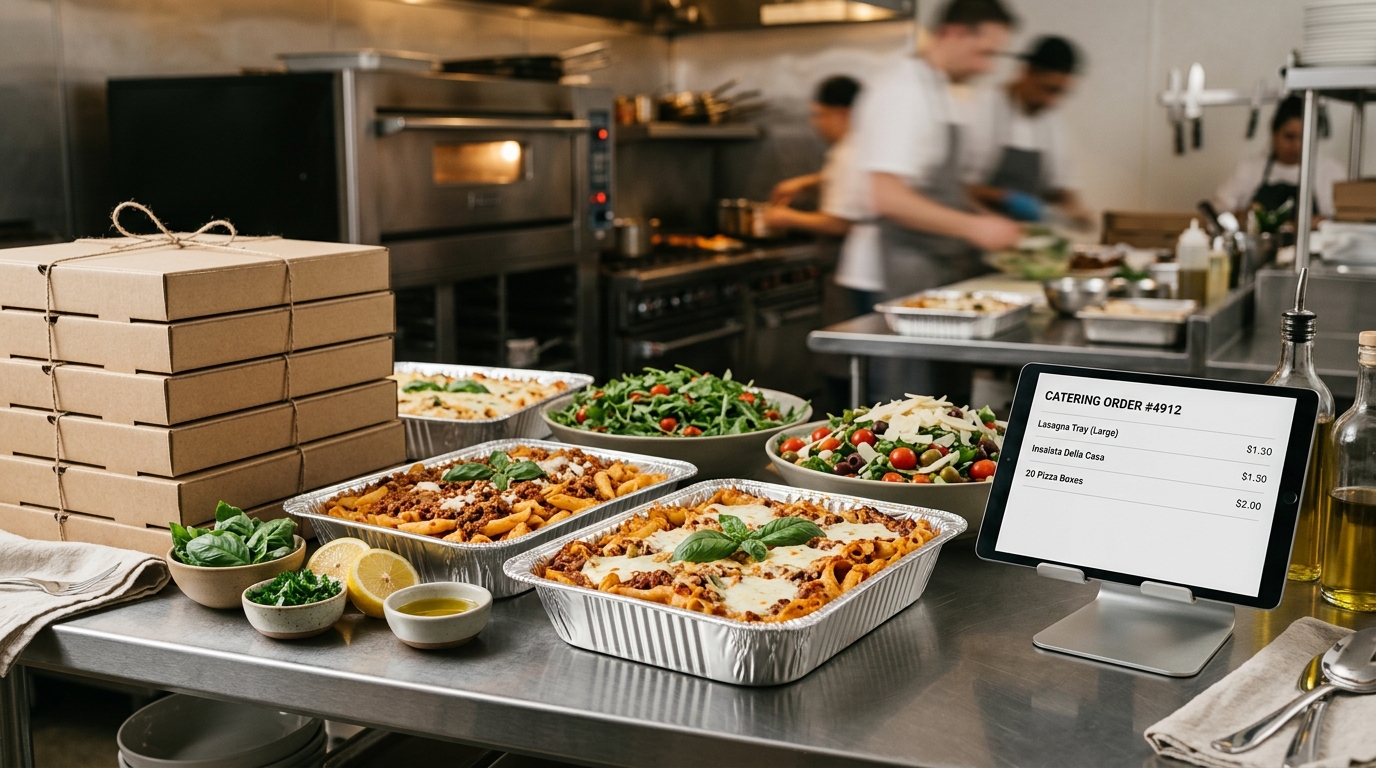
A few weeks of honest numbers, and a pattern surfaced that nobody had been positioned to see before: the catering path was getting meaningful clicks — real people, checking whether Vito's caters — while almost nothing on the site or in the marketing was inviting them in. Catering is the quiet giant of restaurant economics: one inquiry can be worth an entire evening of dine-in covers, ordered days in advance, often by a business that will reorder every quarter. The dashboard was showing unmet demand. So we did the obvious, rare thing: we followed it. Catering became the strategic focus — the path was made unmissable, the inquiry became a first-class tracked conversion the rebuilt ads could hunt for, and the campaign started learning to find event planners and office managers, not just Friday-night families.
The result, in the honest terms we are willing to publish about a client's private business: catering inquiries and orders climbed visibly and stayed up. We do not publish clients' revenue figures or order counts — those numbers belong to Vito's, not to our marketing. But the causal chain is the point of this case study, and it is fully public: honest conversion tracking → an owner dashboard → a data-revealed opportunity → focused strategy → more of the highest-ticket orders in the building. Not one link in that chain was luck.
"Does my website have a dashboard?" — the question to ask your vendor this week
If you take one action from this article, take this one: message whoever manages your website and ads, and ask two questions. One — 'What exactly is counted as a conversion in my Google Ads?' If the answer includes page views, or the answer takes days, you may be funding window shoppers, as Vito's unknowingly was. Two — 'Where is my dashboard?' Not a monthly PDF of screenshots. A live page, yours, showing yesterday's visitors, orders, and revenue paths. A vendor doing honest work will love these questions, because honest work looks better under a light. A vendor who bristles has told you something important. And while you are checking things: confirm your domain is registered in YOUR name, not the vendor's — our guide on buying your domain in your own name walks through why that ten-minute check prevents the ugliest dispute in this industry.